Yesterday, I posted a link to an article by Walter Williams about job outsourcing. Today, I found a series he has written called "Economics for the Citizen." It is a ten part series that will give readers a primer in economics. I went through it this morning and enjoyed it. Here are the links:
Happy reading!
Monday, 31 January 2005

Sunday, 30 January 2005
The Timing of Retirement Planning Returns
Are all returns created equally? Does it matter when you get positive vs. negative returns? When you are saving for a long-term goal like retirement, the likelihood of you having some years with negative returns is pretty high.
The reason I bring all this up is that I have been having an interesting conversation about retirement planning with a fellow on the Saving Advice website. The topic of the conversation was whether or not it matters if you get negative returns the first few years of a long-term goal or the last few years. Here are the assumptions made:
The goal is $1,000,000 thirty years from now. The assumed rate of return is 8%, which requires an annual contribution of $8,827. So, I took that information and plugged it into two different scenarios. The first scenario assumed that the portfolio lost 2% per year for the first 5 years and gained 8% thereafter. The second scenario assumed that the portfolio gained 8% per year for the first 25 years and then lost 2% per year for the last 5 years. I think the chart below makes it pretty clear:
Retirement Savings
Here's what the annual numbers look like:
So, from the looks of this, it is much better to have your losing years in the beginning rather than in the end.
The reason I bring all this up is that I have been having an interesting conversation about retirement planning with a fellow on the Saving Advice website. The topic of the conversation was whether or not it matters if you get negative returns the first few years of a long-term goal or the last few years. Here are the assumptions made:
The goal is $1,000,000 thirty years from now. The assumed rate of return is 8%, which requires an annual contribution of $8,827. So, I took that information and plugged it into two different scenarios. The first scenario assumed that the portfolio lost 2% per year for the first 5 years and gained 8% thereafter. The second scenario assumed that the portfolio gained 8% per year for the first 25 years and then lost 2% per year for the last 5 years. I think the chart below makes it pretty clear:
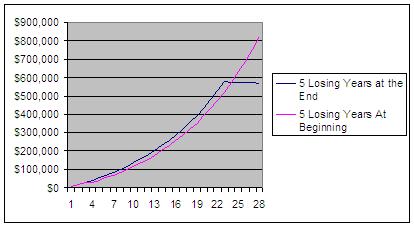
Retirement Savings

Here's what the annual numbers look like:
End of       Account        Account

 Year   ROR    Value   ROR    Value

     2   8%    $9,533  -2%    $8,650

     3   8%   $19,829  -2%   $17,128

     4   8%   $30,948  -2%   $25,436

     5   8%   $42,957  -2%   $33,578

     6   8%   $55,927  -2%   $41,556

     7   8%   $69,935   8%   $54,414

     8   8%   $85,063   8%   $68,300

     9   8%  $101,401   8%   $83,298

    10   8%  $119,046   8%   $99,495

    11   8%  $138,103   8%  $116,987

    12   8%  $158,684   8%  $135,879

    13   8%  $180,912   8%  $156,283

    14   8%  $204,918   8%  $178,319

    15   8%  $230,845   8%  $202,117

    16   8%  $258,845   8%  $227,820

    17   8%  $289,086   8%  $255,579

    18   8%  $321,746   8%  $285,558

    19   8%  $357,019   8%  $317,936

    20   8%  $395,114   8%  $352,904

    21   8%  $436,256   8%  $390,670

    22   8%  $480,690   8%  $431,456

    23   8%  $528,678   8%  $475,506

    24   8%  $580,506   8%  $523,080

    25  -2%  $577,546   8%  $574,459

    26  -2%  $574,645   8%  $629,949

    27  -2%  $571,803   8%  $689,878

    28  -2%  $569,017   8%  $754,602

    29  -2%  $566,287   8%  $824,503
So, from the looks of this, it is much better to have your losing years in the beginning rather than in the end.
Social Security
I found this article (click on the above title) regarding what personal accounts could do for Social Security recipients in the future. I thought this was worth sharing. I welcome any comments you may have regarding Social Security and how to fix it.
Getting Personal
Getting Personal
Saturday, 29 January 2005
Should We Save Jobs?
There has been a lot of talk about jobs and outsourcing lately. I thought this piece by Walter Williams was interesting. I thought this portion of the article was interesting:
"Let's look at some of the history of job loss described in Bradley's article. We might also ponder whether measures should have been taken to save these jobs. In 1858, Lyman Blake patented a shoemaking machine that ultimately destroyed jobs hand making shoes. In 1919, General Motors started selling Frigidaire. As Bradley says, "This 'electric ice box' wiped out a whole set of occupations, including ice-box manufacturers, ice gatherers, and the manufacturers of the tools and equipment needed to handle large blocks of ice.""
You won't find Mr. Williams' view espoused by the media. Anyway, this article is worth a read.
JLP
"Let's look at some of the history of job loss described in Bradley's article. We might also ponder whether measures should have been taken to save these jobs. In 1858, Lyman Blake patented a shoemaking machine that ultimately destroyed jobs hand making shoes. In 1919, General Motors started selling Frigidaire. As Bradley says, "This 'electric ice box' wiped out a whole set of occupations, including ice-box manufacturers, ice gatherers, and the manufacturers of the tools and equipment needed to handle large blocks of ice.""
You won't find Mr. Williams' view espoused by the media. Anyway, this article is worth a read.
JLP
One More Hit and I'll Break 1,000!
It only took me 3 months! Hopefully it won't take that long to break 2,000!
JLP
JLP
Friday, 28 January 2005
You Still Have Time to Make an IRA Contribution for 2004
You have until April 15th (although I recommend you do it sooner than that) to make an IRA contribution for 2004! Also, here's a breakdown of how much you can contribute:
2004 - $3000 per person ($3500 per person if you are over age 50)
2005 - $4000 per person ($4500 per person if you are over age 50)
For more information, check out the IRS Website's Publication 590
Until next time...
2004 - $3000 per person ($3500 per person if you are over age 50)
2005 - $4000 per person ($4500 per person if you are over age 50)
For more information, check out the IRS Website's Publication 590
Until next time...
Taking Money Out of Your Retirement
I spent some time last night running the numbers on a hypothetical retirement withdrawal strategy.
There are a number of ways to withdraw money from your retirement. All of them require you to make a decision as to how much money is necessary to support your lifestyle. The simplest way to make a withdrawal is to take a percentage of the account value out annually and leave the rest of the account to grow. So, if you have a bad year, you could possibly have to take a smaller amount out in the following years.
A more complex strategy is to figure out the amount of money you want to live on and make that your benchmark for year one. Then, each year, you add 3% (or the current inflation percentage) to that number to account for inflation. For example, say you require $50,000 the first year of your retirement. Here is what your annual income would like if you adjusted it for inflation:
It is amazing, and a little scary, to see the impact of inflation (and, I used a modest inflation percentage). What this tells us is that in 20 years at 3% inflation, $87,675 will only be worth what $50,000 is worth today. So, inflation has a BIG impact on retirement plans.
So, with this example, you would simply withdraw the above amounts from your retirement plan each year, regardless of what the account is worth. Some years, you may even eat into the principal.
Tomorrow, I'll discuss another option for taking withdrawals.
Until then,...
There are a number of ways to withdraw money from your retirement. All of them require you to make a decision as to how much money is necessary to support your lifestyle. The simplest way to make a withdrawal is to take a percentage of the account value out annually and leave the rest of the account to grow. So, if you have a bad year, you could possibly have to take a smaller amount out in the following years.
A more complex strategy is to figure out the amount of money you want to live on and make that your benchmark for year one. Then, each year, you add 3% (or the current inflation percentage) to that number to account for inflation. For example, say you require $50,000 the first year of your retirement. Here is what your annual income would like if you adjusted it for inflation:
Year  Income

   1  $50,000

   2  $51,500

   3  $53,045

   4  $54,636

   5  $56,275

   6  $57,964

   7  $59,703

   8  $61,494

   9  $63,339

  10  $65,239

  11  $67,196

  12  $69,212

  13  $71,288

  14  $73,427

  15  $75,629

  16  $77,898

  17  $80,235

  18  $82,642

  19  $85,122

  20  $87,675
It is amazing, and a little scary, to see the impact of inflation (and, I used a modest inflation percentage). What this tells us is that in 20 years at 3% inflation, $87,675 will only be worth what $50,000 is worth today. So, inflation has a BIG impact on retirement plans.
So, with this example, you would simply withdraw the above amounts from your retirement plan each year, regardless of what the account is worth. Some years, you may even eat into the principal.
Tomorrow, I'll discuss another option for taking withdrawals.
Until then,...
Subscribe to:
Posts (Atom)